Sitewalk / Guides / Structured data / FAQ schema
FAQ schema: Google no longer shows it. What to do now
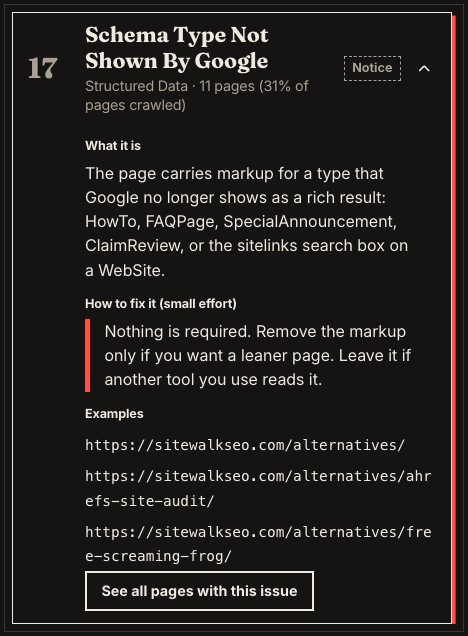
Google's update log says the FAQ rich result "will no longer appear in Google Search starting May 7, 2026". If you added FAQ markup to get those expandable questions under your result, that feature is gone.
Nothing on your site is broken. The markup is harmless, and this guide helps you find it and decide whether to keep it, fix it or remove it.
What changed, and when
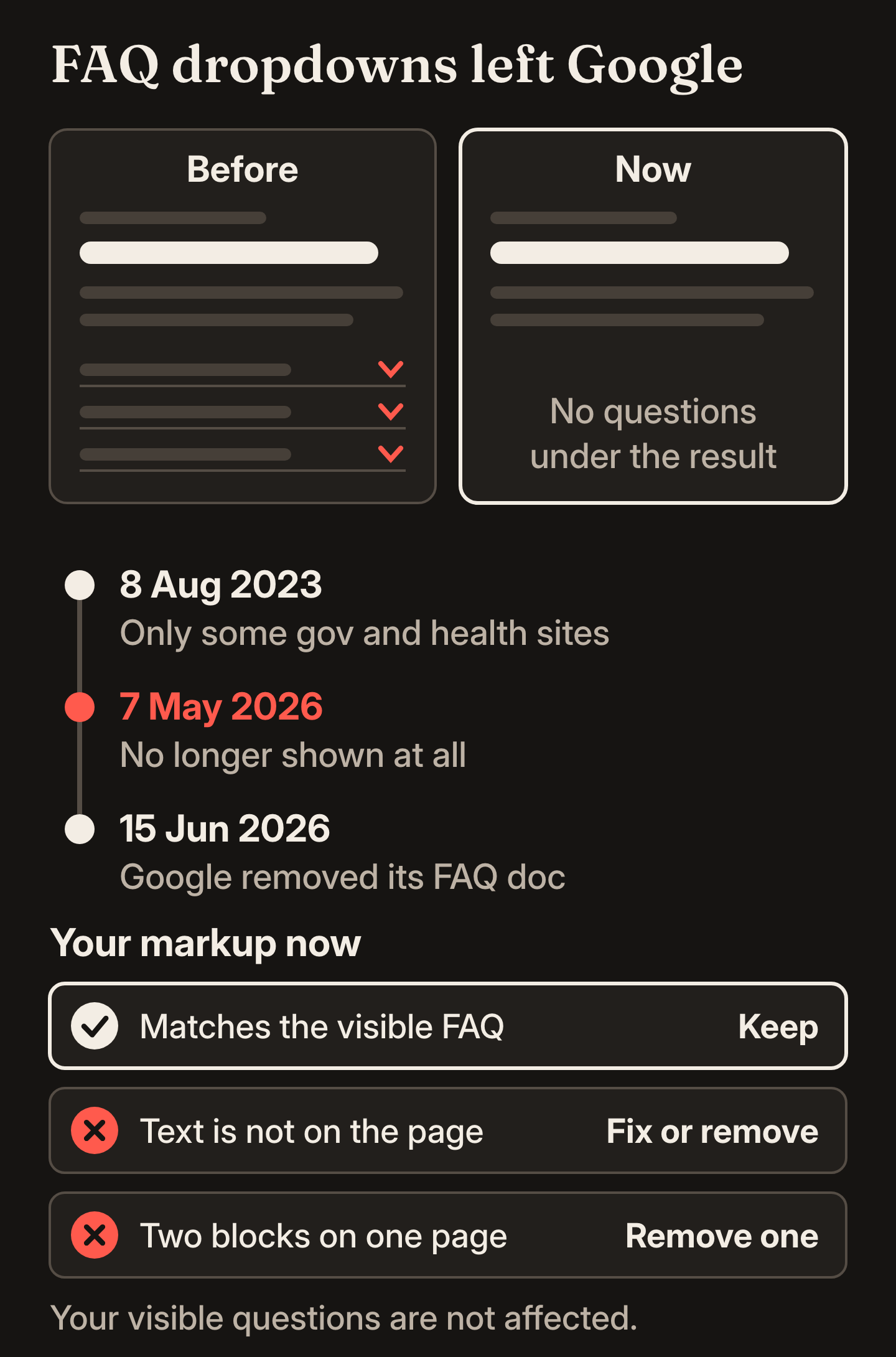
This happened in two steps, and a lot of older advice stops at the first.
| Date | What Google said |
|---|---|
| 8 Aug 2023 | FAQ rich results will only be shown for well-known, authoritative government and health websites. For all other sites they will no longer be shown regularly |
| 7 May 2026 | The FAQ rich result "will no longer appear in Google Search" at all |
| 15 Jun 2026 | Google removed its FAQ rich result documentation, because the feature "is no longer shown in Google Search results" |
You can see the last step yourself. On 23 Nov 2026 the old FAQ documentation address on Google's site sent us to the update log instead of a documentation page.
In the 2023 announcement Google also said you can drop this structured data from your site, but there is no need to proactively remove it. In its words, "Structured data that's not being used does not cause problems for Search, but also has no visible effects in Google Search." That sentence is about FAQ markup, and it is the reason this issue is a notice and not an emergency.
Your visible questions and answers are not affected by any of this. Only the hidden data block is.
What the markup looks like
FAQ markup is a block of JSON-LD in your page that repeats the questions and answers from the visible page in a form a machine can read. This is the shape, using the FAQPage type from schema.org with one question.
<script type="application/ld+json">
{
  "@context": "https://schema.org",
  "@type": "FAQPage",
  "mainEntity": [
    {
      "@type": "Question",
      "name": "How long does shipping take?",
      "acceptedAnswer": {
        "@type": "Answer",
        "text": "Standard shipping takes five business days."
      }
    }
  ]
}
</script>
Schema.org describes a FAQPage as a web page presenting one or more frequently asked questions. The type is still part of schema.org. What changed is that Google stopped using it for a display feature.
How to check yours
The quick way is View Source on a page that has an FAQ section and a search for FAQPage. To check more carefully, this script lists the type of every JSON-LD block on a page, and fails loudly if a block is not valid JSON. Save it as types.py.
import sys, re, json
html = sys.stdin.read()
blocks = re.findall(r'<script[^>]*application/ld\+json[^>]*>(.*?)</script>', html, re.S | re.I)
print(len(blocks), "JSON-LD block(s)")
for b in blocks:
    d = json.loads(b)
    items = d["@graph"] if isinstance(d, dict) and "@graph" in d else (d if isinstance(d, list) else [d])
    for i in items:
        print(" ", i.get("@type"))
Run it against a page.
curl -s https://example.com/faq/ | python3 types.py
We ran it on 23 Nov 2026 against four pages on our own site.
| Page | JSON-LD types found |
|---|---|
| Home page | Organization, FAQPage |
| A guide page about this issue | BreadcrumbList, Article, FAQPage |
| A guide page about thin content | BreadcrumbList, Article, FAQPage |
| The guides index | BreadcrumbList, CollectionPage |
So our home page and our guide pages carry FAQ markup, and the guides index does not. Our home page has 19 marked-up questions, and each guide page marks up the questions in its own questions section. We checked that the text of each one also appears on the visible page.
Look at two things in your own result. First, whether FAQPage appears at all. Second, whether it appears more than once on the same page. Two plugins can each add their own block, and a page should carry one.
Keep it, fix it or remove it
Text version
Google showed FAQ results only for some government and health sites from 8 Aug 2023, stopped showing them on 7 May 2026 and removed its documentation on 15 Jun 2026. Keep markup that matches the visible FAQ, fix or remove markup that does not, and remove a second block.
Google's guidance says either choice is fine. This table is how I would decide.
| Your situation | What to do |
|---|---|
| The markup matches a visible FAQ and nothing complains | Keep it. It costs nothing and does no harm |
| You have to edit templates just to remove it | Keep it and spend the time elsewhere |
| The questions in the markup are not on the visible page | Fix it or remove it. Google's guidance is that structured data matches the visible text |
| Two blocks of FAQPage on one page | Remove one |
| The answers in the markup are out of date | Update the page text first, then the markup. Remove the markup if you will not maintain it |
| You are adding FAQ markup to new pages to get the dropdown in Google | Stop. That feature no longer exists |
| You want a leaner page and the markup is generated by a plugin setting | Turn the setting off and check the page again |
I would not remove a visible FAQ section. People still use them, and an FAQ section is just a set of questions with direct answers, which reads well to anyone.
Does FAQ markup help AI tools? We found no source that says so. Google's guide to generative AI features states that structured data is not required for generative AI search and that there is no special schema.org markup you need to add. It also says to keep using structured data as part of your SEO strategy, because it helps with eligibility for rich results on Google Search.
For ChatGPT and other tools we found no published statement either way. What decides whether those tools can read your page at all is access, which we cover in our guide on AI crawlers and robots.txt.
How to remove it
How you remove it depends on how it got there.
- A plugin or theme setting. Look in your SEO plugin, your FAQ block settings or your theme options for a schema or structured data switch. Turn off the FAQ part, then re-run the check above. Settings differ between plugins, so read yours before you click.
- A hand-written block. Find the
<script type="application/ld+json">block that containsFAQPagein the template, and delete only that block. If the script holds several types in an@graph, delete only the FAQPage item, and keep the JSON valid. - A tag manager. Look for a tag that injects the JSON-LD and pause it.
If you keep the markup, keep it honest. Every question in the block should appear on the page in the same words, with the same answer.
Common mistakes
- Deleting the visible FAQ because the rich result is gone. The section still answers real questions for readers.
- Leaving two FAQPage blocks. Run the script and count.
- Marking up questions that only exist in the code. Google's guide says to make sure structured data matches the visible text on the page.
- Pasting the same FAQ on every page. One shared FAQ belongs on one page.
- Breaking the JSON while editing. A stray comma makes the whole block unreadable. The script above stops with an error when a block is not valid.
- Treating it as a penalty. If your dropdowns disappeared, Google's own log explains why. It was a display change that applied to every site.
Check it worked
- Run
curl -s https://example.com/page/ | python3 types.pyon three pages that used to carry FAQ markup. - Confirm
FAQPageis gone, or that it is there on purpose, once, and matches the visible page. - Load the page in a browser and confirm the visible FAQ is still there.
- Re-run the Sitewalk audit.
What Sitewalk found on real sites
Counted on 23 Nov 2026, from the latest audit of each site.
Sitewalk's check looks for pages that carry a markup type Google no longer shows, and FAQ is one of the types it covers. Of 89 audited sites, using each site's latest audit since the check went live on 4 Nov 2026, 53 (59.6%) had at least one such page. It is the most common structured data finding in our counts.
Sitewalk reports it as information and not as an error, because nothing breaks. This is a small early-user group, a first look and not a survey. The count covers several retired types together, so it is not a count of FAQ markup alone.
Questions people ask
Does Google still show FAQ rich results?
No. Google's update log says the FAQ rich result will no longer appear in Google Search starting 7 May 2026. Before that, since August 2023, it was limited to well-known government and health sites.
Should I remove FAQ schema?
You do not have to. Google said in 2023 that unused structured data does not cause problems for Search and has no visible effect. Remove it if it is wrong, duplicated or hard to maintain. Keep it if it is accurate and costs you nothing.
Is FAQPage still valid schema?
Yes. Schema.org still defines the type. Google just no longer uses it for a rich result.
Will keeping FAQ schema hurt my rankings?
Google's guidance says unused structured data does not cause problems for Search. We found no Google statement that it affects rankings either way, so we make no ranking claim.
Do ChatGPT or other AI tools use FAQ markup?
We found no published statement from OpenAI that says so. Google says structured data is not required for its generative AI features. Write clear questions and direct answers on the page and you are covered either way.
Should I still write an FAQ section?
Yes, if readers ask those questions. A visible FAQ helps people. See our guide on question-style headings for how to write them so each answer is easy to find.
Check your whole site in one sentence
Sitewalk reads the markup on every page it crawls, with 200+ other technical checks. For a related markup check, our guide on Article schema dates and author covers Article markup. In ChatGPT, say:
Audit example.com for technical SEO problems
Checked on 23 Nov 2026. Sources, all read on 23 Nov 2026: Google Search updates, Google: Changes to HowTo and FAQ rich results, 8 Aug 2023, Google: optimizing for generative AI features, Google: AI features and your website, schema.org FAQPage. Counts are from 89 audited sites, each site's latest audit since the checks went live on 4 Nov 2026, counted on 23 Nov 2026: a small early-user group, a first look and not a survey.